

Otitoju Femi
Professor Abel Idowu Olayinka, former Vice-Chancellor of the University of Ibadan (UI), has urged the newly appointed Vice-Chancellor of Federal University Oye-Ekiti (FUOYE), Professor Joshua Olalekan Ogunwole to lead with courage, vision and integrity.
He gave the charge on February 11, 2026, during the inauguration ceremony of Prof. Ogunwole as the fifth substantive Vice-Chancellor of FUOYE.
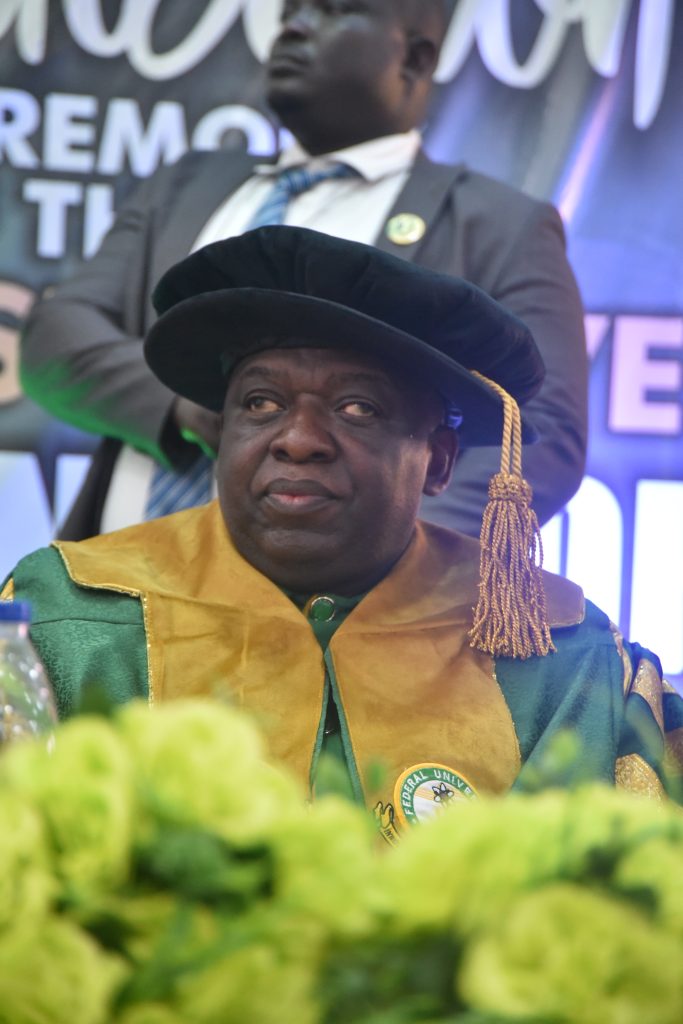
The event was held at the Senator Victor Ndoma-Egba Hall of the university.
Delivering an inaugural lecture titled “Leading Change: Transitioning Universities into High-Performance Research and Innovation Institutions,” Prof. Olayinka spoke extensively on leadership and the future of Nigerian universities.
He noted that Prof. Ogunwole assumed office at a particularly challenging time, as Nigerian universities grapple with financial constraints, administrative pressures, political interference, and academic concerns.

According to Prof. Olayinka, leadership was fundamentally about solving problems while maintaining the trust of the people.
Quoting Colin Powell, he said when people stopped bringing their problems to a leader, leadership had failed.
A true leader, he emphasized, must remain open, accessible, and willing to listen.
Using a vivid metaphor, Prof. Olayinka remarked that an army of sheep led by a lion can defeat an army of lions led by a sheep.
The message, he explained, was that institutions would rise or fall based on the quality of their leadership.
A leader must therefore be bold, focused, and resolute.
Prof. Olayinka reminded the audience that the office of Vice-Chancellor was demanding, stressing as leadership challenges were common in Nigerian universities.
He cited historical examples to illustrate the turbulence that would accompany university administration.
He said: “The late Prof. Ayo Banjo, a respected academic and former Vice-Chancellor of the University of Ibadan, nearly lost his position during his first term despite his commendable record.
“Similarly, the eighth Vice-Chancellor of the University of Port Harcourt was suspended in 2016 following campus unrest but was later reinstated by the Federal Government.”
He shared these instances to prepare the new Vice-Chancellor for unforeseen circumstances, noting that university leadership may be turbulent, requiring strength and patience.
Describing universities as “universe cities,” Prof. Olayinka said they were cities where individuals would grow intellectually and morally, and where students were prepared for careers in medicine, engineering, law, education, and other professions.
He emphasized that universities exist to advance society by generating and disseminating knowledge.
They promote intellectual freedom, rational thinking, respect for evidence, and logical reasoning.
Expanding on this, he explained that university education enhanced employment opportunities, increases earning potential, and develops critical thinking skills for individuals.
For businesses, universities would provide research support, innovation, and a skilled workforce. For nations, strong universities boost productivity, improve public health, reduce crime, and enhance global reputation.
In an increasingly competitive world, he said, sustained investment in education is essential.
Prof. Olayinka further outlined the multifaceted responsibilities of a Vice-Chancellor, describing the role as encompassing chief academic officer, chief administrator, chief accounting officer, chief fundraiser, and chief image-maker of the institution.
As Chairman of Senate, he added, the Vice-Chancellor must safeguard academic standards while ensuring the welfare of both staff and students.
He identified key leadership qualities required for success: vision, competence, humility, networking ability, and the capacity to build a strong team.
He cautioned that a Vice-Chancellor must also be prepared to face criticism, misunderstanding, and even false accusations.
Respect for institutional structures such as the Senate and Governing Council, he stressed, was critical for stability.
However, Prof. Olayinka observed that a five-year tenure would often follow a predictable pattern.
The first year was typically peaceful and marked by goodwill; the second may bring criticism and disappointment from some quarters; the third and fourth years may witness petitions, investigations, and internal conflicts; while the fifth year is often tense due to succession politics.
He advised Prof. Ogunwole to remain principled, carefully document achievements, and adhere strictly to due process in all decisions.
Teamwork, he said, was indispensable. “A Vice-Chancellor cannot succeed alone,” he noted, urging the new Vice-Chancellor to appoint associates who embody integrity, competence, courage, fairness, and loyalty to institutional values.
He warned against individuals driven by personal gain or those whose loyalty shifts with political power, and cautioned against financial misconduct disguised as consultancy advice.
He also reminded Prof. Ogunwole that there was life after office, urging him to safeguard both his health and reputation.
Prof. Olayinka concluded by stressing that the success of a university depended on collective effort management, staff, students, governing bodies, and the wider community.
While the Vice-Chancellor bore significant responsibility, he said, meaningful progress would only be achieved through cooperation and shared commitment.


